The Invisible Threat: Inside the npm Supply Chain Crisis
It starts with a simple command: npm install. It’s the heartbeat of modern development,
a ritual we perform dozens of times a day. But with every keystroke, we aren't just downloading
libraries—we’re inviting thousands of strangers into our codebase, handing them keys to our
production servers, and hoping they aren't hiding a knife.
This isn't paranoia. It’s the new reality of the software supply chain. The recent "Shai-Hulud" attack proved that the era of "trusting open source" is effectively over. We’ve moved from theoretical risks to automated, self-replicating worms that hunt for your cloud secrets while you sleep.
The Reality Check
The modern npm ecosystem relies on an "implicit social contract" that is now fundamentally broken. A simple "hello-world" React app pulls in over 100 packages before you write a single line of code. 40% of these packages are "ghosts"—dependencies you didn't ask for, maintained by people you'll never meet.
1. Anatomy of a Nightmare: The "Shai-Hulud" Worm
Forget manual hacks. Shai-Hulud wasn't a script kiddie trying to deface a website; it was a fully autonomous cyber-weapon. It marked a terrifying shift in how supply chain attacks operate.
How It Happened (A Reconstruction)
- 01. The Trap It begins with a targeted phishing email disguised as an npm security alert. A legitimate maintainer, perhaps tired or rushed, clicks a link. In seconds, their credentials are gone.
-
02. The Infection
The worm wakes up. It doesn't just infect one package; it scans everything the
maintainer owns.
It automatically downloads valid tarballs of popular libraries (like
@ctrl/tinycolor, downloaded 2.2M times weekly), injects a maliciouspostinstallscript, updates the version number, and republishes them. -
03. The Harvest
Millions of developers wake up and run
npm update. The infected package lands on their machines. The payload triggers instantly. It scans for AWS keys, SSH credentials, and environment variables, sending them silently to a command-and-control server.
2. The "Trust Paradox" in Open Source
We tend to equate popularity with security. If a package has 10 million downloads, it must be safe, right? Wrong.
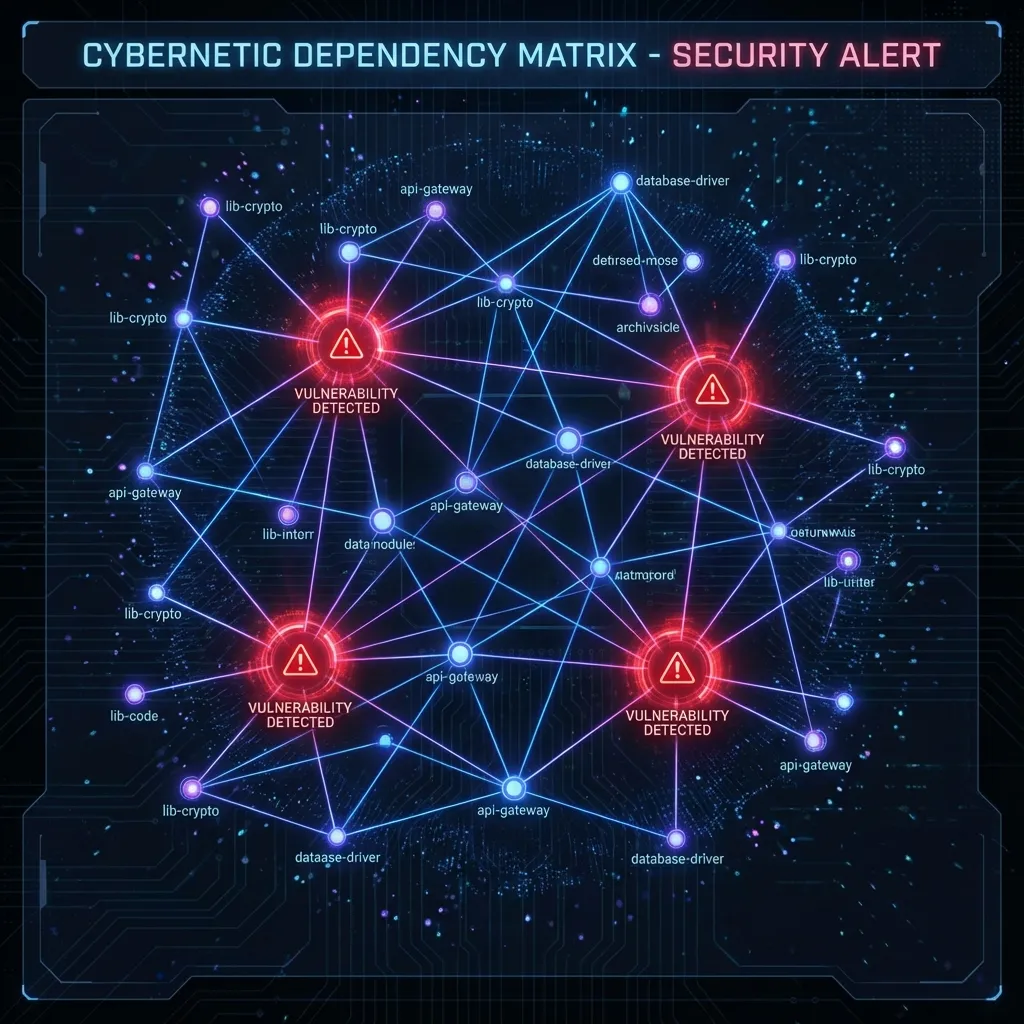
Figure 1: The sprawling, interconnected web of modern dependencies. Red nodes indicate potential vulnerability points.
Research reveals a dangerous "Trust Paradox." High-profile developers—the "rockstars" of the open source world—are often the least scrutinized. We assume their code is gold, so we skip the audit. Attackers know this. They don't target the obscure libraries; they target the celebrities. Compromise one "central" node, and you compromise the entire network.
The "Ghost" Clone Problem
To escape "dependency hell," many maintainers have started copy-pasting code directly into their projects ("shrinkwrapping"). It sounds safer, but it creates "Ghost Clones". These are snippets of code with no metadata, no history, and no link to the original author.
"Self-Contained"
scanners
When a vulnerability is found in the original code, the scanner alerts the original author. But the "ghost clone" remains silent, unpatched, and vulnerable forever. It's invisible technical debt.
3. Fighting Back: The New Defense Playbook
Traditional "scanning" is dead. You cannot scan your way out of a problem where the threat is the system itself. We need a fundamental architectural shift.
| Strategy | The "Old" Way | The "New" Way (Zero Trust) |
|---|---|---|
| Identity | Long-lived API Tokens | OIDC & Trusted Publishing |
| Installation | npm install (Blind trust) |
npm ci --ignore-scripts |
| Provenance | "It looks correct" | Sigstore & in-toto attestation |
The Role of AI in Defense
We are now deploying Large Language Models (LLMs) like Cerebro to read code for us.
But the attackers are adapting. They use "mild obfuscation"—splitting malicious strings into
harmless
variables (e.g., const a="pas"; const b="te";)—to confuse the AI's reasoning.
It's an arms race. The AI looks for patterns; the attacker breaks the pattern. Our only defense is defense-in-depth: combining AI analysis with strict policy enforcement (like blocking network access during install).
Final Investigation Notes
The Shai-Hulud attack wasn't an anomaly; it was a prototype. The next generation of supply chain malware will be smarter, quieter, and faster.
My advice? Stop treating npm as a utility and start treating it as
an
external vendor effectively operating inside your firewall. Audit your dependencies. Use
lockfiles.
And never, ever assume a package is safe just because everyone else is using it.