Identity and Access Management (IAM)
Network Security and Management VI: Identity and Access Management (IAM)
Chapter 1: Fundamentals of Identity and Access Management
Access to data and systems, the cornerstone of the modern digital economy, represents both the greatest opportunity and the most serious security risk for organizations. At the center of this dilemma is Identity and Access Management (IAM), one of the most critical disciplines of cyber security. This chapter aims to create a solid theoretical basis on the subject by thoroughly examining the definition, strategic importance, basic principles and modern architecture of IAM.
1.1. IAM: Definition, Scope and Strategic Importance
Identity and Access Management (IAM), in its most basic definition, is a set of cyber security policies, processes and technologies that enable the right people or assets (people, machines, software components) to access the right resources (applications, data, systems), at the right time and for the right reasons. This discipline covers the processes of creating, managing, protecting and de-provisioning digital identities.
In the past, network security relied heavily on a "perimeter" defense built around the physical boundaries of the organization. Technologies such as firewalls and VPNs separated trusted users "inside" from threats "outside." However, the proliferation of cloud computing, the standardization of the remote working model, the integration of mobile devices into corporate networks, and the rise of new technologies such as generative artificial intelligence have virtually eliminated this traditional security perimeter. Resources and users are now geographically dispersed, which has significantly expanded the attack surface. According to a study by IBM X-Force, 30% of cyber attacks are carried out through theft and misuse of valid user accounts. In this new paradigm, the real environment that needs to be protected is not the network, but the "identity" itself.
This transformation has moved IAM's role from a reactive "gatekeeper" to a proactive "business risk and opportunity manager". An effective IAM strategy is no longer just an IT cost item, but a strategic investment that directly affects the organization's cyber resilience, legal compliance, operational agility and market competitiveness. In addition to reducing the risk of data breaches by preventing unauthorized access, IAM systems increase productivity by improving user experience with technologies such as Single Sign-On (SSO) and automating access management processes. At the same time, it supports new business models and creates competitive advantage by providing secure access to external users such as business partners and customers. Therefore, the success or failure of an IAM program has become one of the key factors that determine the overall success of an organization in today's digital ecosystem.
1.2. Basic Principles
To understand the functioning of IAM systems, three basic concepts need to be clearly distinguished. These concepts correspond to the basic questions the system asks at each stage of an access request.
1.2.1. Identity:
A digital asset that uniquely represents a person, a machine (e.g., a server), a software component (e.g., an API), or a device in a computer system. These digital identities include identifying information such as username, email address, employee number, and the roles, groups, and other attributes assigned to that identity. In modern IAM architectures, these credentials are securely stored and managed by a central identity provider (IdP) such as Microsoft Entra ID (formerly Azure AD) or Okta. This centralization makes it easier to consistently enforce authentication and authorization policies, monitor user behavior, and detect suspicious activity.
1.2.2. Authentication:
When a user or entity asks the system "Who am I?" It is the process of verifying the answer to the question. In other words, it is confirmation that "you are the person or entity you claim to be." This verification is done using one or more authentication factors. These factors generally fall into three categories:
- Something you know: Password, PIN code, answer to security question.
- Something you have: One-time code (OTP) received on the mobile phone, a security key (security token), smart card.
- Something you are (Biometrics): Fingerprint, facial recognition, iris scan.
It is now generally accepted that passwords alone do not provide a sufficient security layer due to reasons such as being stolen, forgotten or weak. Therefore, standard practice for modern IAM systems is Multi-Factor Authentication (MFA), which requires the use of factors from at least two different categories.
1.2.3. Authorization:
When a successfully authenticated user or entity asks, "What can I do with this resource?" is the answer given by the system to the question. This process determines which resources (files, databases, applications) the authenticated identity can access and what operations (read, write, delete, execute) they can perform on these resources. To use a popular analogy, if authentication is permission to enter the main door of a building, authorization is the keys that determine which rooms you can enter and what you can do in those rooms.
The distinction between these two concepts forms the basis of modern security architectures, especially the Zero Trust philosophy. In traditional security models, successful authentication (for example, logging into a VPN) typically gave the user wide authority within the network. This was an approach based on the assumption of "implicit trust". Zero Trust architecture works on the principle of "never trust, always verify". In this model, authentication is just the first step. Each user's resource access request (opening a file, querying a database, etc.) is subjected to a separate authorization check. These checks evaluate not only the validity of the identity, but also the context in which the access request is made (security status of the device, geographic location of the user, time of day, risk level of the request, etc.). This situation necessitates the transformation of IAM systems from a static rule engine into a context-sensitive, dynamic decision mechanism.
1.3. Modern IAM Architecture: Four Pillars
A comprehensive enterprise IAM strategy is a set of capabilities that work integrated with each other and meet different security needs, rather than a single technology or product. Industry analysis shows that a modern IAM framework is generally built on four key pillars or pillars.
1.3.1. Identity Governance and Management (IGA):
This pillar (Identity Governance and Administration) asks "who should have access to what?" It addresses the question from a governance perspective. IGA manages the entire lifecycle of user identities and access rights. Its main abilities are:
- Identity Lifecycle Management: It ensures that access rights are automatically assigned and removed during processes such as provisioning, role change and de-provisioning of users.
- Access Request and Approval Workflows: Offers automated workflows where users can request the access rights they need and these requests will be approved by administrators.
- Access Certification/Review: It prevents the accumulation of unnecessary permissions by ensuring that administrators periodically review and approve or revoke the current access rights of users in their teams.
- Segregation of Duties (SoD): Enforces policies that prevent a user from simultaneously having conflicting powers (for example, creating invoices and authorizing payment) that would increase the risk of fraud or error.
1.3.2. Access Management (AM):
This pillar asks "how do users access resources?" focuses on the question. AM provides the necessary technological infrastructure for the verification and authorization of users. Its main abilities are:
- Authentication: Implements strong authentication methods including Multi-Factor Authentication (MFA).
- Single Sign-On (SSO): Allows users to access multiple applications with a single set of credentials.
- Federation: Supports standard protocols such as SAML, OpenID Connect (OIDC) and OAuth, which enable secure sharing of credentials between different institutions or systems.
1.3.3. Privileged Access Management (PAM):
This pillar focuses on protecting the organization's most sensitive assets: (Privileged Access Management )"privileged accounts". These are accounts with broad privileges such as system administrators, database administrators, root users and service accounts. PAM is one of the most critical security controls because compromise of these accounts could allow an attacker to control the entire system. PAM solutions store the passwords for these accounts in a secure vault, tightly control access, record sessions, and enforce the principle of least privilege.
1.3.4. Directory Management:
This pillar includes the management, security, and health of directory services (e.g., Microsoft Active Directory, LDAP) that underlie corporate identity data. These central repositories where identities and groups are held are the primary data source for all other IAM components.
1.3.5. Result:
Historically, organizations have often used separate and independent (siloed) solutions for these four functions. However, this approach leads to lack of visibility, inconsistent policies, and security gaps. For example, a user's access may be removed through an IGA tool, while their privileged access in the PAM tool may remain. The market is evolving towards solutions that bring these four pillars under a single "unified identity platform" or at least provide seamless integration between these pillars. This unified approach fundamentally strengthens security by managing all access vectors of an identity (standard, privileged, cloud, on-premises) from a holistic perspective and creates a modern architecture called "identity security fabric".
Chapter 2: Key Components and Technologies of IAM Systems
Following the conceptual framework discussed in the first section, this section will examine in detail the basic technological components and mechanisms that make up IAM systems. From the identity lifecycle to authentication protocols, from authorization models to privileged access controls, each component is critical to understanding the functioning of a modern IAM architecture.
2.1. Identity Lifecycle Management
Identity Lifecycle Management is a set of automated workflows that cover the entire process from creation to deletion of a digital identity. This process has a direct impact on an organization's security posture and operational efficiency.
- Provisioning: This process begins when a user (employee, contractor, business partner) joins the organization or the role of an existing user changes. The IAM system is triggered by a signal from an authorized source, such as the Human Resources (HR) system, and automatically creates all required accounts for the user (e.g., Active Directory, email, enterprise applications) and assigns appropriate access permissions based on predefined roles. This automation makes it faster for new employees to be productive on their first day and eliminates human errors and delays in manual account creation processes.
- De-provisioning: When a user leaves the organization, immediate, complete and auditable removal of access rights is vital for security. With manual processes, it is a common problem that a user's accounts on some systems are forgotten or delayed in removing their access. This creates a serious vulnerability known as "orphaned accounts" that can be exploited by former employees or attackers. Automated de-provisioning immediately and consistently terminates a user's access across all systems with a "quit" signal from the HR system.
This lifecycle management is also the primary way to prevent a dangerous situation that occurs over time, called "role creep" or "permission bloat." As employees move to different roles within the organization, they can continue to maintain the access permissions of their old roles. Over time, this leads to them having too much authority and violates the principle of least privilege. Effective lifecycle management prevents this buildup by automatically removing old permissions and assigning new ones at the time of role change. Therefore, a successful IAM implementation requires not only technology integration but also close collaboration and standardized processes between HR and IT departments.
2.2. Authentication Mechanisms
Authentication is the cornerstone of IAM and refers to the process of proving a user's identity when logging into the system. The modern threat environment necessitates a continuous evolution in this field.
2.2.1. Multi-Factor Authentication (MFA) and the Passwordless Future
The traditional username and password combination is highly vulnerable to threats such as phishing, brute-force attacks, and password leaks. To address this vulnerability, Multi-Factor Authentication (MFA) has now become a standard. MFA requires the user to provide at least two different types of evidence to verify their identity.
However, requiring additional steps from the user with each login attempt can negatively impact the user experience. To achieve this balance, Adaptive Authentication or Risk-Based Authentication approaches have been developed. These systems analyze the context of a login attempt. If the user is logging in from a familiar device, a secure network, and during normal business hours (low risk), a password alone may be sufficient. However, if the user is trying to log in from an unknown device, from a different country, or in the middle of the night (high risk), the system will automatically request an additional verification step (for example, confirmation from the mobile app).
The next step in the evolution of authentication is Passwordless Authentication, which aims to eliminate passwords altogether. Technologies such as security keys based on the FIDO2 standard (for example, YubiKey), platform biometrics such as Windows Hello or Apple Face ID, and "passkeys" allow users to authenticate without a password, more securely and more easily. This approach increases security by eliminating the vulnerability that forms the basis of password-based attacks, while also significantly improving the user experience.
2.2.2. Single Sign-On (SSO): Working Principles and Benefits
Single Sign-On (SSO) is an authentication method that allows users to access multiple independent applications and services with a single set of credentials (for example, their corporate email and password). When the user first logs into the application, they verify their identity against a central identity provider (IdP). After successful authentication, the user can access other integrated applications (Service Provider - SP) during the same session without entering the password again.
The main benefits of SSO are:
- Improved User Experience and Productivity: It reduces "password fatigue" and speeds up workflows by eliminating the need for users to remember and enter dozens of different passwords.
- Increased Security: Since users only have to remember a single password, it is easier to ensure that password is stronger and more complex. Additionally, fewer password reset requests reduces a vulnerability to social engineering attacks.
- Centralized Access Control and Auditing: Because all authentication processes go through a central IdP, it becomes easy to enforce access policies (such as MFA) from a single place and centrally record and audit all login attempts.
SSO is based on a digital trust relationship established between an IdP and SPs. This trust is achieved using digital certificates and encrypted "tokens," usually through standard protocols such as SAML or OIDC.
2.2.3. Technical Protocol Comparison: SAML vs OpenID Connect (OIDC)
The two main federation protocols that form the technical infrastructure of SSO are SAML and OIDC.
- SAML (Security Assertion Markup Language): It is a mature and widely adopted XML-based standard that has been around since 2005. It is specifically designed to provide SSO between enterprise, browser-based web applications. SAML transmits authentication and authorization information through digitally signed XML documents called "SAML Assertion". After authenticating the user, the IdP creates this assertion and redirects it to the SP via the user's browser. The SP grants access to the user by checking the signature and validity of the assertion.
- OpenID Connect (OIDC): A more modern authentication layer built on the OAuth 2.0 authorization framework. Unlike SAML, it uses JSON instead of XML for data exchange and RESTful APIs. This makes it lighter, less complex and developer-friendly. OIDC transmits identification information in compact and secure tokens called JSON Web Token (JWT). It is especially ideal for modern architectures, mobile applications and single-page applications (SPA).
The choice between SAML and OIDC is more of a strategic decision than a technical choice. For an organization whose current application portfolio consists largely of legacy, browser-based enterprise software, SAML can still be a strong option. However, for new generation applications that are mobile-first, API-focused and built on modern web technologies, OIDC is a more natural and efficient solution. In today's complex enterprise environments, hybrid IAM platforms that can support both protocols offer the most flexible approach.
2.3. Empowerment Models: Strategic Comparison
Authorization is a set of rules that determine what resources an authenticated user can access and what they can do with those resources. How these rules are defined and implemented depends on the authorization model used.
2.3.1. Role-Based Access Control (RBAC)
RBAC is the most widely used authorization model. In this model, access permissions are assigned to "roles" rather than directly to individual users. Users are assigned to these roles and inherit all the permissions of that role. For example, the "Accounting Specialist" role is granted "write to billing system" and "read to reporting tool" permissions. When Alice and Alice are assigned to this role, they both automatically have these permissions.
Advantages:
- Simplicity and Manageability: Especially when the number of users is large, it is much easier to manage a few roles rather than assigning permissions to hundreds of users one by one.
- Scalability: When a new user arrives, it is sufficient to assign him the appropriate role. When the permissions of a role change, the permissions of all users with that role are automatically updated.
- Principle of Least Privilege: It facilitates the implementation of the principle of least privilege by assigning users only the roles required by their job descriptions.
Challenges:
- Role Explosion: As the organization grows and job descriptions diversify, there may be a tendency to create new roles for many exceptional situations. This can lead to hundreds or even thousands of roles to be managed, destroying the simplicity of the model.
2.3.2. Attribute-Based Access Control (ABAC)
ABAC is a much more dynamic and granular authorization model. Access decisions are made based on policies created in real time, based on a set of "attributes" and not just the user's static role. These features may include:
- User Properties: Role, department, security clearance level, administrator.
- Source Properties: Type of file, sensitivity level of the data (for example, "Within the Scope of KVKK"), creation date.
- Environment Features: Access time (inside/outside business hours), geographical location of the user, type and security status of the device used, network connection (company network/public network).
- Action Properties: The action to be performed (read, write, delete).
For example, an ABAC policy might read: "IF the user is in the role 'Doctor' AND the resource being accessed is labeled 'Patient Record' AND the doctor is that patient's physician of record AND the access request is from the hospital network, THEN ALLOW the 'read' action."
Advantages:
- Flexibility and Granularity: Provides highly granular and context-aware access control.
- Dynamic Decisions: Can adapt immediately to changing conditions (e.g. a threat level increases).
Challenges:
- Complexity: Defining, implementing and managing policies is much more complex than RBAC and requires significant pre-planning.
2.3.3. Hybrid Models and Enterprise Application Scenarios
RBAC and ABAC are not mutually exclusive models. The most effective approach in modern corporate environments is often to adopt a hybrid strategy that combines the strengths of both models. Organizations can simplify management by defining global and static access rights (for example, access to a department's public file server) with RBAC. You can then use ABAC policies as an additional layer of security for access to sensitive data, critical systems, or high-risk operations.They can apply it. This approach combines the operational efficiency of RBAC with the granular security control of ABAC. Choosing the right model depends on the organization's structure, data sensitivity, and compliance requirements. For example, for a small business with a simple structure, RBAC may be sufficient, while for a financial institution or healthcare organization subject to strict regulations, the detailed control offered by ABAC is indispensable.
2.4. Privileged Access Management (PAM): Protecting Critical Assets
Privileged Access Management (PAM) is a specialized discipline within the overall IAM framework that focuses on protecting the organization's most valuable and riskiest assets.
2.4.1. Importance of PAM and Differences from General IAM
Privileged accounts have powers far beyond standard user accounts. These; Identities such as system administrator (administrator), root user, database administrator (DBA) and service accounts that manage critical infrastructure. These accounts have powers such as configuring systems, installing software, changing user accounts, and unrestricted access to sensitive data. Therefore, they are a prime target for cyber attackers; because the compromise of a single privileged account could mean losing control of an entire infrastructure. The vast majority of data breaches involve the abuse or compromise of privileged access, which explains why PAM is at the heart of modern cyber defense.
While general IAM governs "who can access what resources," PAM much more specifically controls "what highly privileged identities can do with those privileges," subjecting those activities to much more stringent control and monitoring mechanisms.
2.4.2. Core Capabilities: Vaulting, Session Management and Principle of Least Privilege
An effective PAM solution is built on three core capabilities:
- Credential Vaulting: This is the basis of PAM. Passwords, SSH keys, and other "secrets" of privileged accounts are stored in a digital vault that is highly encrypted and access is tightly controlled. Passwords are automatically changed (password rotation) based on policy (for example, after each use or periodically), without human intervention. This eliminates the risk of passwords being shared or stolen.
- Privileged Session Management: When an authorized user wants to use a privileged account, he establishes an "intermediary" (proxy) connection through the PAM system instead of connecting directly to the target system. In this way, the PAM system can monitor the entire session from start to finish, record it as video and log text-based commands. Security administrators can monitor live sessions and immediately terminate the session if they detect suspicious activity. These records provide invaluable evidence for forensics and audits following a security incident.
- Least Privilege Enforcement: The ultimate goal of PAM is to eliminate "standing privileges", that is, the ability of an administrator to have full authority 24/7. Instead, Just-in-Time (JIT) Access and Just-Enough-Access (JEA) principles apply.
- JIT Access: Privileged access is granted to a user only when he or she needs it to perform a specific task, through an approval process, and for a limited period of time. Access is automatically removed when the time expires.
- JEA: The user is granted permission to perform the minimum commands and actions necessary for his/her role, not full administrative authority.
This approach dramatically reduces the likelihood that an attacker will take over a privileged account and make lateral movement, even if they infiltrate the network.
2.5. Auditing, Reporting and Compliance
Auditing and reporting is a core function that provides visibility of an IAM system and establishes accountability. IAM platforms produce detailed audit logs that record all significant events that occur in their systems. These records answer critical questions such as:
- Who requested access to a resource?
- Who** approved this request?
- When and where did the user log into the system?
- What resources** did he access and what actions did he take after logging in?
Collecting these logs in a central place and using a SIEM (Security Information and Event Management)Integrating it with your system allows security teams to proactively detect anomalies (for example, a user trying to access a server they normally never access in the middle of the night) and quickly respond to security incidents.
Additionally, these audit trails and the reports produced by IAM systems are also vital for legal compliance. Regulations such as GDPR, KVKK, SOX, HIPAA require organizations to prove who has accessed sensitive data and demonstrate the effectiveness of access controls. Regular access review reports are a way to prove that you are avoiding "permission bloat" and adhering to the principle of least privilege. Therefore, auditing and reporting capabilities turn IAM from just a prevention tool into a detection, response, and compliance evidence tool.
Chapter 3: Enterprise IAM Implementation Strategies and Best Practices
Once you understand the theoretical foundations and technological components, implementing an Identity and Access Management program on an enterprise scale is a complex process that requires strategic planning, phased implementation, and adoption of security best practices. This chapter will draw the roadmap of a successful IAM project, discuss modern security philosophies, offer solution strategies to common challenges, and detail the legal compliance aspect, especially within the framework of KVKK.
3.1. Stages of a Successful IAM Project: Developing a Roadmap
A comprehensive IAM project should proceed in carefully planned, phased and manageable steps rather than a "big bang" approach. This minimizes risks, ensures early wins, and facilitates organizational adoption of the project. A successful IAM implementation roadmap typically includes the following nine key phases :
- Project Initiation and Roadmap Development: In this first phase, the sponsors of the project are determined and a cross-functional project team is formed, including representatives from HR, IT, security, legal and business units. The overall objectives of the project, the business case, and the Key Performance Indicators (KPIs) that determine how success will be measured are clearly defined.
- Requirements Gathering and Evaluation: Existing identity and access management processes, used systems and existing policies are analyzed. Business, compliance and technical requirements are thoroughly documented through workshops and interviews with stakeholders. This phase reveals gaps and areas for improvement in the current situation.
- Solution Architecture and Design: Based on the collected requirements, a technical architecture is created focusing on security, scalability and flexibility. Disaster recovery, redundancy and business continuity plans are designed as part of this architecture.
- Installation, Configuration and Integration: The selected IAM tools are installed and configured in accordance with the designed architecture. Automation workflows are customized and integrated with existing systems such as the IAM platform, Active Directory, HR systems, and critical business applications.
- Migration and Data Migration Planning: Identity data in existing systems is cleaned, validated and prepared for migration to the new IAM system. Small-scale pilot runs are conducted to verify data integrity. The rollout is planned to be phased to minimize business disruption.
- Verification and Quality Assurance: Comprehensive functional tests, security tests (including penetration tests) and User Acceptance Tests (UAT) are performed on the system. The performance of the system is measured by stress tests that simulate real-world conditions.
- Training and Knowledge Transfer: Customized training materials and sessions are organized for different user groups such as administrators, end users and IT support teams. IAM processes and policies are documented in detail for long-term governance.
- Going Live and Dissemination: The planned "go-live" strategy is activated. The solution is deployed with live monitoring and rapid response capabilities. Any issues that may arise are addressed quickly to maintain business continuity.
- Review, Measurement and Improvement: After the project goes live, feedback is collected from stakeholders. The success of the project is measured by comparing the results obtained with the targets and KPIs determined at the beginning. IAM program, changing business needs and emergingIt is constantly reviewed and improved to adapt to current security threats.
This phased approach emphasizes that IAM is not just a technology project, but also a business transformation project that impacts business processes, organizational roles and corporate culture. Its success depends on strong leadership support and stakeholder engagement.
3.2. Best Practices: Zero Trust, Least Privilege, and JITÂ Access
A modern and effective IAM strategy should be based on proactive security philosophies rather than reactive measures. The most important of these philosophies are:
- Zero Trust Architecture: This model rejects the traditional "trusted internal network, untrustworthy external network" distinction. Its basic principle is "never trust, always verify". According to this approach, regardless of whether an access request comes from inside or outside the network, every request is considered a potential threat. Every user and device must re-prove their identity and authority when they try to access a resource. IAM forms the basis of Zero Trust architecture because it positions identity as the center of the security perimeter.
- Principle of Least Privilege (PoLP): This principle advocates granting users, applications and systems the absolute minimum level of access rights and authorizations necessary to perform their tasks. For example, if a marketing professional needs to analyze customer data, they should only have the authority to "read" that data, not "modify" or "delete" it. This policy limits the potential damage an attacker can do if an account is compromised.
- Just-in-Time (JIT Access): This approach, which is especially critical for privileged accounts, is a dynamic application of the principle of least privilege. Instead of users or administrators being assigned elevated privileges on an ongoing basis, they are granted only when they need it, through an approval mechanism, and for a specified period of time (e.g., "administrator access to the server for 2 hours"). When the period expires, privileged access is automatically revoked. This significantly narrows the attack surface by eliminating "standing privileges".
These three principles form an intertwined and complementary structure. Zero Trust offers an identity-centric security model. Least Privilege statically reduces the potential attack surface these identities have. JIT Access proactively manages risk by dynamically shrinking this surface so that it exists only when needed. This is the most concrete expression of IAM's transition from reactive to proactive security.
3.3. Common Challenges and Solution Strategies (With Sample Scenarios)
Enterprise IAM projects are inherently complex and can face a variety of technical, process, and cultural challenges.
- Challenge: Complexity and Integration: Large organizations often have legacy systems and hundreds of cloud-based SaaS applications (app sprawl) with disparate technologies that have accumulated over the years. Integrating the IAM system into this heterogeneous structure can be technically challenging.
- Solution Strategy: A comprehensive inventory and compatibility analysis should be carried out before starting the project. It is critical to choose a flexible IAM platform that supports standard protocols such as SCIM, SAML, OIDC, has a large connector library, and is API-focused. Integration should be done in stages, starting with the most critical applications.
- Challenge: Scalability and Performance: As the organization grows, the number of users, devices, and applications that the IAM system must manage increases. This can cause authentication processes to slow down and user experience to degrade.
- Solution Strategy: It must be ensured that the architecture of the selected IAM solution is horizontally scalable. Cloud-based IDaaS solutions, in particular, offer a natural solution to this problem thanks to their ability to automatically scale with demand.
- Challenge: User Resistance and Adoption: New steps introduced to increase security, especially additional authentication requirements such as MFA, may be perceived as an obstacle by users and may be met with resistance on the grounds that they slow down their workflow.
- Solution Strategy: This is more of a change management problem than a technological problem. The solution has three legs:
1-Technology: Prefer solutions that least impact user experiencepush notifications (for example, push notifications or risk-based adaptive MFA with one-tap approval instead of entering a code each time).
2-Communication: Conducting a continuous communication campaign that clearly explains why new security measures are necessary and how they protect both the organization and the users themselves.
3-Training: Providing practical training to users on how to use new systems. - Challenge: Lack of Centralized View: Particularly in large and decentralized organizations, different departments or business units may set up their own access control mechanisms for their applications. This makes it impossible to implement a consistent security policy across the organization and get a holistic view of who has access to what.
- Solution Strategy: With senior management support, a governance model should be created that aims to unify all identity and access management processes under a central IAM platform. This platform should serve as the "single source of truth" for the entire organization.
3.4. Legal Compliance: Technical and Administrative Measures for KVKK and GDPR
Legal regulations such as the Personal Data Protection Law No. 6698 (KVKK) and the European Union General Data Protection Regulation (GDPR) oblige institutions that process personal data (data controllers) to ensure the security of this data. Article 12 of the KVKK clearly states that data controllers are "obliged to take all necessary technical and administrative measures" in order to "prevent unlawful access to personal data". IAM plays a central role in meeting these obligations.
An effective IAM system serves as a "proof mechanism" for KVKK compliance. In the event of an audit or data breach, the institution's questions such as "who has the authority to access which personal data?", "when and on what grounds was this authority given?" and "are these accesses audited?" It provides concrete and auditable answers to critical questions such as:
IAM's contribution to KVKK technical and administrative measures can be summarized as follows:
Technical Measures:
- Authority Control and Authorization Matrix: IAM platforms create the technical infrastructure of an authorization matrix that limits employees' access to personal data in accordance with their job descriptions, through RBAC and ABAC models.
- User Account Management and Access Logs: Implementing strong password policies, strengthening authentication with MFA, and detailed logging of all access attempts and user transactions are among the basic requirements of KVKK.
- Encryption and Data Masking: IAM systems indirectly contribute to the protection of sensitive data by controlling access to it. Some IAM solutions may also support additional controls such as data masking.
Administrative Measures:
- Application of the Principle of Least Privilege: IAM technically applies the "need to know" principle, ensuring that employees only have access to personal data that is essential for their job.
- Data Minimization: Automated de-provisioning processes ensure the timely deletion of user accounts and their associated access rights that are no longer needed, reducing the risk of unnecessary personal data retention.
- Access Policies and Audit: IAM enables the central definition and implementation of the organization's access control policies. Periodic access review processes are a critical administrative measure to monitor the effectiveness of these policies.
As a result, IAM transforms the abstract obligations specified in Article 12 of the KVKK into concrete, applicable and auditable controls. Therefore, it is not just a "recommended" tool for KVKK compliance, but a "mandatory" set of technologies and processes to effectively fulfill basic data security obligations.
Chapter 4: IAM Market Analysis: Products, Providers and Solutions
The Identity and Access Management market is a rapidly growing and constantly evolving ecosystem due to increasing cyber threats, the proliferation of cloud computing and tightening legal regulations. In this section, the main distribution models in the market will be compared, market leaders and platforms will be examined in the light of the reports of leading analysis companies such as Gartner, and critical criteria will be presented to choose the IAM solution that best suits corporate needs.
4.1. Deployment Models: On-Premise vs. Cloud-Based (IDaaS) Solutionsto be given
Organizations can basically deploy IAM solutions in two different models: on-premise and cloud-based (IDaaS - Identity as a Service). Both models have their own advantages and disadvantages.
On-Premise IAM:
In this model, IAM software is installed and managed on the organization's own servers in its own data centers.
- Advantages: Provides full control over data and infrastructure. This is a significant advantage, especially for sectors such as finance, healthcare and government, which contain sensitive data and are subject to strict regulations. Integration with legacy systems is generally more manageable.
- Disadvantages: Requires high initial cost (hardware, software licenses, installation). Maintaining, updating, securing and scaling the software is entirely the responsibility of the organization's IT team, which requires a serious operational burden and expertise.
Cloud Based IAM (IDaaS - Identity as a Service):
In this model, the IAM service is hosted on the cloud by a third-party provider and organizations access this service via a subscription model over the internet.
- Advantages: Offers low initial cost because it does not require hardware and infrastructure investment (operational expenditure - OpEx rather than capital expenditure - CapEx). Maintenance, updates and security patches are managed by the service provider, reducing the burden on IT teams. It can easily scale with demand, providing great flexibility for companies that are growing or whose workload fluctuates.
- Disadvantages: Control over data and infrastructure is shared with the service provider. There is a dependency on the internet connection. In some cases, complex or custom integration requirements may be more difficult to meet.
Hybrid (Hybrid) IAM:
This model uses a combination of on-premise and cloud-based solutions. Enterprises can leverage IDaaS services for less critical or cloud-based applications while keeping their most sensitive identity and access management processes in their own data centers. This approach aims to strike a balance between control and flexibility and is often the most realistic solution for today's complex IT environments.
The market trend is clearly shifting towards the IDaaS model. However, the final decision; It depends on a number of factors, including the organization's security posture, compliance requirements, existing infrastructure, budget and strategic goals. The table below summarizes these two models to assist in the decision-making process.
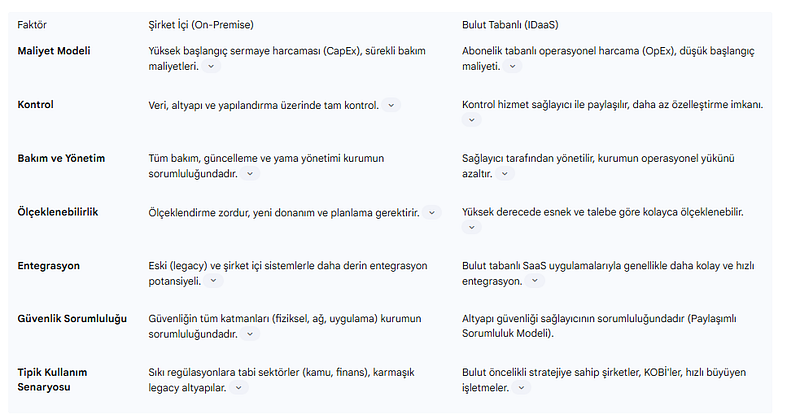
Comparison of On-Premise and Cloud (IDaaS) IAM Solutions
4.2. Market Leaders and Platform Reviews (Based on Gartner Analysis)
The IAM market is generally analyzed by leading analysis firms such as Gartner into three main segments: Access Management (AM), Identity Governance and Administration (IGA) and Privileged Access Management (PAM). Each segment has leading players who specialize in their field.
4.2.1. Access Management (AM) Leaders
This segment focuses on topics like SSO, MFA, adaptive authentication, and API security.
- Okta: The pioneer and often considered the leader of the IDaaS market. Its strengths include its easy-to-use interface, comprehensive Multi-Factor Authentication (MFA) options, and Okta Integration Network (OIN) with over 7,000 pre-built integrations. Okta,
- It offers two main platforms for managing employee and partner identities with Workforce Identity Cloud and customer identities with Customer Identity Cloud (strengthened with the acquisition of Auth0).
- Microsoft (Entra ID): It is a natural and powerful option, especially for institutions that use Microsoft 365 and Azure ecosystem extensively. Microsoft Entra ID, formerly known as Azure Active Directory (Azure AD), offers a wide range of services, from SSO and MFA to advanced features such as Identity Protection and Conditional Access. Microsoft has been positioned by Gartner as a leader in Access Management for the eighth year in a row.
- Ping Identity: Known for flexible and powerful solutions designed for complex enterprise and hybrid IT environments. It offers in-depth capabilities in both workforce and customer identity scenarios. Especially large-scale and specializedIt is a suitable option for organizations with high marketing needs.
4.2.2. Identity Governance and Management (IGA) Leaders
This segment focuses on governance-focused topics such as identity lifecycle, access requests, access reviews, and compliance reporting.
- SailPoint: Considered the founder and long-time leader of the IGA market. It offers in-depth features, especially for large organizations with complex compliance (SOX, HIPAA, etc.) and governance needs. It has a strong presence in the market with its on-premise solution called IdentityIQ and SaaS platform called Identity Security Cloud. It aims to make access decisions smarter by using artificial intelligence and machine learning capabilities.
- Saviynt: It is a modern IGA platform that stands out with its cloud-native architecture. Saviynt's core strategy is to offer different identity security disciplines such as IGA, PAM and Application Access Governance (AAG) in a single unified platform, which it calls The Identity Cloud. This approach aims to provide more holistic security and governance by eliminating silos.
4.2.3. Privileged Access Management (PAM) Leaders
This segment focuses on the security of administrator accounts, service accounts, and other high-authority identities.
- CyberArk: is the creator and most recognized leader of the PAM market. Its core product is Privileged Access Manager, built on patented Digital Vault technology. It is known for its comprehensive threat detection, session monitoring, and least privilege enforcement capabilities. In recent years, a general
- With its vision of Identity Security Platform, it has gone beyond PAM and expanded into the areas of access management and identity management.
- Delinea: It is a strong leader that emerged from the merger of Thycotic and Centrify, two important players in the industry.
- It is known for its Secret Server product and stands out especially with its ease of use, fast deployment and flexible architecture. It appeals to a wide customer base by offering both cloud and on-premise deployment options.
- BeyondTrust: Provides a comprehensive PAM platform with strong capabilities in endpoint privilege management â€" EPM and secure remote access. Its platform combines privileged password and session management with privilege escalation controls on servers and endpoints.
The general trend in the market shows a shift from the "best-of-breed" approach to the "unified platform" approach that combines multiple IAM functions on a single platform. The efforts of companies such as CyberArk and Saviynt to offer IGA and PAM capabilities under one roof are the most prominent examples of this trend. This provides ease of management and a more integrated security posture for organizations, while increasing competition and market consolidation among vendors.
4.3. Criteria for Choosing the Right IAM Solution According to Corporate Needs
There are so many powerful options on the market that it can make choosing the right IAM solution difficult. There is no such thing as the "best" IAM solution; Instead, there is a solution that best "fits" the organization's specific needs, priorities, and strategic goals. The following criteria should be carefully considered during the selection process :
- Business Needs and Scale: The size of the organization, number of employees, geographical distribution and complexity of business processes are decisive for the scalability and management capabilities of the solution.
- Technology Infrastructure and Integration: What is the institution's current infrastructure (on-premise, cloud, hybrid)? A critical factor is how easily and deeply the IAM solution can integrate with the existing technology stack such as Active Directory, HR systems, SIEM and critical business applications.
- Use Scenarios: What is the primary need? SSO and MFA (Access Management) only for employees? Or complex access review and compliance reporting (IGA)? Or security of critical infrastructure (PAM)?
- Compliance and Security Requirements: What are the legal regulations (KVKK, GDPR, SOX, etc.) and industry standards (PCI DSS, ISO 27001, etc.) to which the institution is subject? The solution must have auditing and reporting capabilities to meet these requirements.
- User and Administrator Experience: How intuitive and frictionless the solution is for end users (critical for adoption) and how easily manageable it is for IT/security administrators (critical for operational efficiency) should be evaluated.
- Total Cost of Ownership (TCO): Evaluatione should include not only the initial license or subscription fee, but also the internal and external resource costs required for installation, integration, maintenance, training and management.
The selection process should be approached not just as a technical product comparison, but as a strategic exercise that considers the current state of the organization and its future growth and digital transformation roadmap.
Chapter 5: IAM Engineer: Role, Responsibilities and Required Competencies
The success of Identity and Access Management systems depends not only on choosing the right technology, but also on the presence of competent professionals to design, implement and manage these systems. The IAM Engineer is the expert who takes on this critical role and combines technical depth and security vision. This section discusses in detail the job description, areas of responsibility, technical and social skills and career path of an IAM Engineer.
5.1. Job Description and Responsibilities of an IAM Engineer
An IAM Engineer is responsible for the end-to-end lifecycle of an organization's IAM infrastructure. This includes continuously optimizing existing IAM services, keeping the system up to date by following new technologies and security regulations, and helping to resolve IAM-related security issues. This role may also be referred to as IAM Consultant or IAM Architect at times.
The main areas of responsibility are:
- Design and Implementation: Designing, installing and configuring IAM solutions that suit the needs of the organization. This includes developing access control mechanisms, authentication protocols, and authorization policies.
- Integration: Seamlessly integrating the IAM platform with existing IT infrastructure such as Active Directory, LDAP, HR systems, cloud services and enterprise applications.
- Identity Lifecycle Management: To manage workflows that enable the automatic creation, updating and removal (provisioning/de-provisioning) of users' accounts and access rights during employment, position change and exit processes.
- Access Control and Policy Management: Implementing access policies using technologies such as SSO, MFA, RBAC and ABAC and ensuring that these policies remain up-to-date.
- Monitoring and Incident Response: Continuously monitoring access logs and security events, detecting suspicious or abnormal activities and minimizing the risk of security breaches by intervening in these events.
- Troubleshooting and Support: Troubleshooting issues that arise regarding identities, system access, authentication, authorization and permissions and provide technical support to end users.
- Compliance and Audit: To ensure that the IAM system complies with legal regulations and industry standards such as KVKK, GDPR, SOX and to prepare the necessary reports and evidence for audit processes.
- Documentation: Documenting IAM policies, procedures and system configurations in a clear and understandable manner.
These responsibilities ensure that the IAM Engineer is not just a system administrator; It shows that he also takes on the roles of a security architect, a process automation expert, and a business analyst.
5.2. Required Technical Skills: Platform Expertise, Scripting, Federation Protocols
A successful IAM Engineer must have a broad range of technical competencies :
- Platform Expertise: In-depth knowledge and practical experience in at least one of the leading IAM platforms in the market (e.g. Okta, Microsoft Entra ID, SailPoint, CyberArk, Ping Identity).
- Directory Services: Expertise in the architecture, management and security of directory services such as Microsoft Active Directory and LDAP, the fundamental repository of corporate identities.
- Federation and SSO Protocols: Mastery of the working principles and implementation details of standard protocols such as SAML, OAuth 2.0, OpenID Connect (OIDC), which form the basis of modern authentication. It is also important to know the SCIM (System for Cross-domain Identity Management) protocol used for user provisioning automation.
- Scripting and Automation: Proficiency in scripting languages ​​such as PowerShell or Python to automate repetitive tasks, write custom integrations, and create complex workflows. This skill is becoming increasingly critical as modern IAM requires connecting systems together through APIs.
- **Cloud Platforms:**Having knowledge about local identity and access management services of major cloud providers such as AWS IAM, Azure (Entra ID), Google Cloud IAM.
- Security Fundamentals: Have a solid understanding of network security (TCP/IP, DNS, HTTP/S), SSL/TLS certificates, encryption (cryptography) fundamentals and general cybersecurity principles.
- Operating Systems and Network: Knowledge of Windows and Linux server management basics and network infrastructure.
5.3. Required Soft Skills and Certifications
Technical expertise is only part of the equation. An IAM Engineer also needs strong soft skills to be able to translate technical solutions into business needs and be effective within the organization:
Soft Skills:
- Analytical Thinking and Problem Solving: Ability to analyze complex access problems, find root cause, and design effective solutions.
- Communication and Collaboration: Ability to explain complex technical issues in simple language to non-technical stakeholders (HR, legal, business unit managers) and work in harmony with different teams.
- Detail Orientation: A careful and meticulous work habit, as even the smallest detail of access controls and policies can have major security implications.
- Continuous Learning: The desire to follow new technologies, threats and best practices and constantly update oneself, as the field of cybersecurity and IAM is constantly evolving.
- Certifications: Certifications are an effective way to prove a candidate's knowledge and expertise. Certifications that are considered valuable in the IAM field include:
- General Cybersecurity Certifications: Certifications such as CISSP (Certified Information Systems Security Professional) issued by (ISC)² and CISM (Certified Information Security Manager) or CISA (Certified Information Systems Auditor) issued by ISACA are considered the industry standard for general security understanding and governance knowledge.
- Vendor Specific Certifications: Certifications offered by leading IAM platform providers such as Okta (Okta Certified Professional/Administrator), Microsoft (Microsoft Certified: Identity and Access Administrator Associate) document expertise on a specific technology.
5.4. Career Path and Development Opportunities
A career in IAM typically begins in entry-level IT roles such as systems administration, network administration, or general cybersecurity. After gaining basic infrastructure and security experience in these roles, candidates can focus on specializing in IAM.
A typical career path might go like this:
- IAM Analyst / Specialist: Responsible for the day-to-day management of IAM operations, meeting user requests and basic troubleshooting.
- IAM Engineer: Responsible for the design, implementation, integration and automation of systems.
- Senior IAM Engineer / IAM Architect: Determines the organization's overall IAM strategy and architecture, manages complex projects and leads the adoption of new technologies.
- IAM Program Manager / Leader: Manages the IAM program's budget, road map and team, and ensures compliance with business goals.
- Senior Security Executive (CISO, etc.): As identity becomes the center of security, professionals with a strong IAM background become strong candidates for top strategic security roles such as Chief Information Security Officer (CISO).
Specializing in emerging fields such as cloud security, AI-powered identity analytics, and decentralized identity offers significant advancement opportunities in an IAM professional's career. Given increasing cyber threats and the pace of digital transformation, IAM specialization will continue to be one of the most sought-after, most stable and most strategic career paths in cybersecurity.
Chapter 6: The Future of IAM: Emerging Trends and Technologies
Far from being a static discipline, Identity and Access Management is a dynamic field that constantly evolves with technological innovations and a changing threat landscape. This final chapter will examine the most important trends shaping the future of IAM, providing strategic insights on how organizations can prepare for the security architecture of the future. The role of artificial intelligence, the decentralized identity revolution and recommendations for the future are the main focuses of this section.
6.1. The Role of Artificial Intelligence (AI) and Machine Learning (ML): Anomaly Detection and Adaptive Access
Artificial intelligence (AI) and its subfield, machine learning (ML), have the potential to fundamentally transform IAM paradigms. Traditional IAM systems rely heavily on predefined, static rules. AI/ML gives these systems the ability to learn, adapt and predict, making them more intelligent, proactive and autonomous.
The main application areas of AI/ML in IAM are:
- Behavioral Analysis and Anomaly Detection: ML algorithms create a "normal" behavioral profile for each user by analyzing large amounts of access logs and user activity data. This profile can include dozens of parameters, such as which devices, from which locations, at what times and which applications the user usually accesses. The system can detect in real time any activity (anomaly) that deviates from this normal profile. For example, if an employee's credentials are stolen and an attacker tries to log in to the system from a different country at midnight with this information, the AI-supported IAM system can mark this situation as an anomaly and produce an immediate alert or automatically block access. This is
- It is called continuous behavioral authentication and provides a strong layer of defense against attacks with stolen credentials.
- Adaptive and Predictive Access: AI transforms IAM from a reactive control mechanism to a proactive risk management tool.
- Adaptive Access: The system instantaneously evaluates the risk level of an access request and dynamically adjusts authentication requirements. A low-risk request (for example, a login to the office network from a known device) will be approved without any problems, while a high-risk request (for example, access to a sensitive database from a new device) may automatically require an additional MFA step (step-up authentication).
- Predictive Access: AI models can predict future access needs by analyzing organizational patterns. For example, by detecting that an employee has been promoted or moved to a different department in the HR system, the system can prepare in advance the access rights he will need for his new role and submit it to his manager for approval. This both speeds up onboarding processes and increases security compliance.
- Autonomous Remediation: Perhaps the most transformative application is the ability of AI-supported systems to take action autonomously against the threats they detect, without human intervention. When suspicious activity is detected, the system may temporarily suspend the account, restrict access to sensitive resources, or trigger an automatic password reset process. This dramatically reduces the critical window of vulnerability between when a security breach occurs and when it is responded to. According to a report from SailPoint, organizations with autonomous remediation capabilities respond to identity threats 96% faster than those that rely on manual processes.
This integration transforms IAM from a static, rule-based system into a dynamic, context-aware and self-learning "smart security brain."
6.2. Decentralized Identity and Self-Sovereign Identity â€" SSI
The current digital identity model is largely centralized. Our identities are stored in databases controlled by third-party identity providers such as large technology companies such as Google, Facebook or the institutions we work with. Self-Sovereign Identity â€" SSI is a revolutionary approach that challenges this paradigm.
SSI's core philosophy is to give individuals full control and ownership over their digital identities. In this model, identity data and credentials are collected from a server under the user's control, rather than a central server.
Stored securely in a digital wallet, usually on a mobile device. The user decides what information he will share with whom and when.
SSI architecture is based on three key actors, often referred to as the "trust triangle":
- Issuer: It is the authorized institution that creates and digitally signs the verifiable credential. For example, a university may issue a digital diploma, a government agency may issue a digital driver's license.
- Holder: The individual who stores these credentials in their own digital wallet and controls them.
- Verifier: It is the party that requests proof of identity to provide a service and verifies the validity of this proof (by checking the digital signature of the Giver). For example, an employer can verify the validity of a candidate's digital diploma.
This structure is generally built on Distributed Ledger Technologies (DLT) such as Decentralized Identifiers â€" DIDs and Blockchain. DIDs are globally unique identifiers that are not tied to any central authority. Blockchain acts as a "trust anchor" where Issuers' digital signatures (more precisely, the public keys needed to verify these signatures) are recorded in a reliable and immutable manner.
Potential benefits of SSI include:
- Increased Privacy and Control: Users have full control over their data and can only share the minimum information necessary for a service (selective disclosure). For example, a person who needs to prove their age to enter a venue may only present evidence from their wallet verifying that they are "over 18 years of age" rather than showing their full driver's license.
- Reduced Risk of Data Breach: Because identity data is not collected in central databases, the risk and impact of large-scale data breaches is reduced.
- Improved User Experience: Users can reuse verified proofs from their digital wallets instead of entering the same information over and over again for each new service.
While SSI has the potential to fundamentally change the current IAM model, it is still in the early stages of development. There are significant challenges, such as technical complexity, imperfect global standards, and uncertainty of legal frameworks. However, initiatives such as the European Union's eIDAS 2.0 indicate that SSI will be an important part of digital identity in the future.
6.3. Strategic Insights and Recommendations for the Security Architecture of the Future
The future of IAM is moving towards a smarter, more automated and more integrated structure. The strategic approaches that organizations should adopt to prepare for this future are:
- Intelligence-Focused Investment: IAM platforms of the future will be equipped with AI/ML capabilities. Organizations should invest in solutions that not only enforce static rules but can also perform behavioral analysis, predict risks, and offer adaptive controls. This will enable security teams to move from a reactive stance to a proactive stance.
- Comprehensive Automation (Hyperautomation): All manual and repetitive processes such as identity lifecycle management, access requests, periodic reviews and compliance reporting should be automated as much as possible to minimize human error and maximize operational efficiency. "No-code" or "low-code" automation platforms (e.g. Okta Workflows) will play an important role in this area.
- Merger and Consolidation: The silos between traditional IAM, IGA and PAM will gradually disappear. The strategic vision is to manage all identity types (employee, customer, partner, machine, API) and all access types (standard, privileged) from a single unified platform. This ensures consistent policies are implemented, holistic visibility is achieved, and total cost of ownership is reduced.
As a result, organizations should no longer treat IAM as a series of standalone technology projects, but as a continuous and dynamic strategic program integrated with business objectives that forms the basis of Zero Trust security architectures. Investments should be directed towards flexible, API-driven unified identity platforms enriched with artificial intelligence and automation capabilities. This approach will enable organizations to be resilient not only against today's threats, but also against tomorrow's unknown risks.
Chapter 7: IAM Protocols: A Comprehensive Technical Review
Identity and Access Management (IAM) is the discipline of ensuring that the right people, machines or software components have access to the right resources at the right time, as the cornerstone of digital security. Achieving this fundamental goal requires countless applications, systems and services developed independently of each other to speak a common language. This is where standardized protocols come into play. Protocols ensure interoperability between different systems and manufacturers.rability), providing a framework for securely and consistently validating credentials, assigning privileges, and managing access.
Protocols are not just technical documents that define data exchange formats; They also form the basis for establishing a digital "trust relationship" between different domains or organizations. This trust model ensures that the assertion generated by an Identity Provider â€" IdP after authenticating a user is accepted without question by a Service Provider â€" SP. This process, which starts with a certificate exchange at a technical level, actually digitizes a business logic between two institutions: The IdP is responsible for verifying the user; SP provides its service by relying on this verification. Without this bridge of trust, modern Cloud and Business-to-Business (B2B) integrations would require proprietary, costly and insecure solutions for each connection.
This report will examine in depth the basic protocols that make up the IAM ecosystem, classifying them on the axis of authentication, authorization, administration and auditing, which are the main functions of IAM. The analysis will be structured around the following main categories:
- Federation and Single Sign-On (SSO) Protocols: Standards that allow users to access multiple systems with a single credential.
- Authorization Frameworks: Mechanisms that enable a user to grant limited permissions to third-party applications over their data.
- Directory Services Protocols: Protocols used to query and manage central identity stores.
- User Provisioning Protocols: Standards that automate the lifecycle of user identities.
7.1. Federation and Single Sign-On (SSO) Protocols
Federation and SSO form the foundation of modern enterprise IT infrastructures, increasing user productivity and reducing password fatigue. Prominent protocols in this field offer different architectural approaches and usage scenarios.
7.1.1. SAML (Security Assertion Markup Language): The Cornerstone of the Corporate World
SAML is a mature open standard based on XML designed specifically for securely exchanging authentication and authorization data between enterprise web applications. Its architecture is based on two main roles: user authenticator
Identity Provider (IdP) and the service that the user wants to access; Service Provider (SP).
At the heart of a SAML-based SSO flow are XML documents called Assertion that are digitally signed by the IdP. These statements can contain three basic types of statements about the user: authentication statements that specify who is authenticated when and how, attribute statements that include the user's attributes such as email or department, and authorization decision statements that specify whether the user can access a particular resource.
SAML is described as "heavy" and "complex" because of its XML-based structure and detailed configuration requirements. However, this complexity is not a weakness, but a consequence of the flexibility and security needed at the enterprise level. Mature standards such as XML schemas, XML Signature and XML Encryption give SAML a high level of security, granular control and rich data carrying capacity. These features make SAML indispensable for B2B federation scenarios in highly regulated industries such as finance and healthcare.
7.1.2. OAuth 2.0: Modern Authorization Framework
OAuth 2.0 is a critical standard that is often misunderstood but forms the foundation of modern application architectures. It should be emphasized that OAuth 2.0 is not an authentication protocol, but an authorization framework. Its main purpose is to allow a user (Resource Owner) to grant a third-party application (Client) limited and timed access to his/her own data hosted on a resource server (Resource Server). This process is a
It is managed by the Authorization Server and as a result, an Access Token is issued to the client.
The rise of OAuth 2.0 is a direct result of software architectures evolving from monolithic to API-driven microservices. Traditional applications areWhile working as a whole, modern applications often consist of different services (user profile, payment, notification, etc.). OAuth 2.0 acts as the "glue" that allows services in this distributed structure to talk to each other securely. Each API call is authorized with the Access Token owned by the client. This is specifically the underlying mechanism behind scenarios like "Allow ABC app to access your profile picture by connecting with Facebook" and addresses a modern problem that SAML was not designed to solve.
7.1.3. OIDC (OpenID Connect): Identity Layer Over OAuth 2.0
While OAuth 2.0 solved the authorization problem, it did not provide a standard method for authentication. To fill this gap, OpenID Connect (OIDC), a thin identity layer built on OAuth 2.0, was developed. In addition to OAuth 2.0 flows, OIDC includes basic credentials about the user and
It offers a special token called ID Token.
ID Token is a digitally signed data package in the JSON Web Token (JWT) format and contains standard user claims such as iss (issuer), sub (subject), aud (audience). In this way, the client application not only receives access authorization to a resource, but also obtains reliable information about the authenticated user. Thanks to its REST/JSON-based structure, OIDC offers an ideal solution especially for modern web applications, single page applications (SPA) and mobile applications.
One of the key factors behind OIDC's rapid adoption is its prioritization of developer experience â€" DX. Unlike SAML's challenges such as XML parsing, OIDC's use of technologies that modern developers are already familiar with, such as RESTful APIs and JSON, significantly simplifies and speeds up the integration process. This has made OIDC the default option for new projects in today's technology world where time to market is critical.
7.1.4. Other Federation Standards: Kerberos and WS-Federation
- Kerberos: It is a ticket-based, mature and secure authentication protocol used to provide SSO in internal networks, especially in Microsoft Windows Active Directory (AD) domain environments. Once the user authenticates, they receive tickets that they can use to access different services on the network.
- WS-Federation (WS-Fed): It is a web services federation standard conceptually similar to SAML, developed by Microsoft and used especially in integration with Microsoft products such as Active Directory Federation Services (AD FS).
7.2. Directory Services Protocols
7.2.1. LDAP (Lightweight Directory Access Protocol): Query Language of Identity Stores
LDAP is not a database; Rather, it is an application protocol that runs over TCP/IP and is used to access, query, and manage hierarchical directory services based on the X.500 standard, such as Microsoft Active Directory. Hierarchical structure, objects
It identifies them in unique ways called Distinguished Names (DN). Interaction with the directory is established through basic operations such as bind, search (search), add (add), modify (change).
LDAP is the basic protocol that ensures corporate identity as a "Single Source of Truth". It enables hundreds of different applications to authenticate and query attributes by connecting to a central directory (usually Active Directory) via LDAP, rather than keeping user credentials in their own databases. This architecture centralizes identity management, ensures data consistency, and enables consistent enforcement of security policies from a single point. When an employee's password or department changes in AD, this change is immediately reflected in all integrated systems that connect to LDAP.
7.3. Automatic User Provisioning Protocol
7.3.1. SCIM (System for Cross-domain Identity Management): Automation of the Identity Lifecycle
SCIM is an open standard designed to automate the process of creating, updating and deprovisioning user identities between different systems, especially cloud-based SaaS applications. Its RESTful API and JSON-based architecture make integration with modern applications extremely easy.
SCIM, "Least Privilege" and "Zero Trust"It is a critical tool that ensures operational implementation of modern security principles. Security policies require users to access only the resources they need, for the time they need them. Applying these policies manually is slow, costly, and error-prone. For example, when an employee's role in the HR system changes, SCIM detects this change and automatically updates their authorizations in all relevant SaaS applications; removes old privileges and assigns new ones. This automation prevents "privilege creep" and dynamically narrows the organization's attack surface. Without SCIM, strategic security concepts such as Zero Trust are doomed to remain largely theoretical.
7.4. Comparative Protocol Analysis and Selection Criteria
In modern IAM architectures, protocol selection often requires a decision between SAML and OIDC. Although both protocols offer strong SSO capabilities, they have different technical foundations and ideal use cases. Making the right choice depends on factors such as the type of application, existing infrastructure, and developer resources. The table below summarizes the key differences between these two basic protocols.
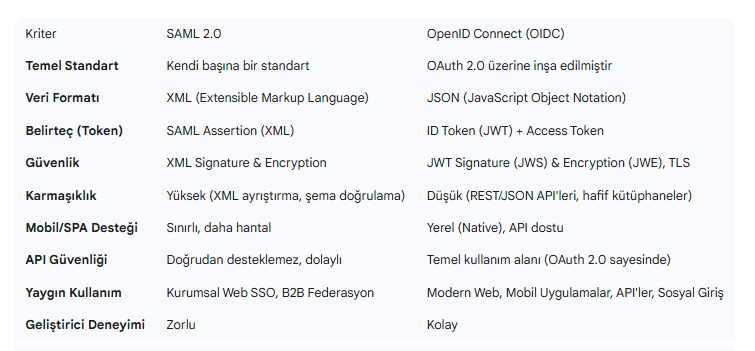
Technical and Usage Area Comparison of SAML and OIDC Protocols
This table serves as a decision-making matrix. For example, for a project that requires integration with existing enterprise applications, SAML's maturity and rich features may be more suitable, while for a modern mobile application developed from scratch, OIDC's lightweight and developer-friendly structure provides a clear advantage.
7.5. Data Formats and Tokens Underlying Protocols
Identity data carried by protocols are encapsulated in tokens in certain formats. The structure of these tokens directly affects the efficiency and security of the protocol.
7.5.1. JWT (JSON Web Token): Bearer of Modern Identity
JWT is a compact, self-contained open standard used to securely transmit information between parties as a JSON object. A JWT consists of three parts separated by periods:
- Header: Contains the type of the token (
typ) and the signing algorithm used (alg). - Payload: Contains claims such as user ID (
sub), token issuer (iss), target audience (aud) and expiration date (exp). - Signature: Created by signing the header and payload using a secret key or private/public key pair. This signature verifies that the token was not altered during transmission and was sent by the correct party (JSON Web Signature â€" JWS).
JWT's compact structure allows it to be easily transmitted in space-constrained environments such as HTTP headers or URL parameters, making it an indispensable part of OIDC and OAuth 2.0 ecosystems.
7.5.2. XML and SAML Assertions
Unlike JWT, SAML Assertions are in XML format. XML guarantees the accuracy of the data thanks to its strict schema (XSD)-based structure, but it is more verbose than JWT and requires more resources to process. However, mature standards such as XML Signature and XML Encryption offer proven and widely accepted security mechanisms at the enterprise level.
7.6. Conclusion: Evolution of Protocols and Future Perspective
The history of IAM protocols is a journey that reflects the evolution of information technologies and ways of doing business. The transition from Kerberos, designed for corporate internal networks, to SAML, which became standardized with the rise of the web, and finally to the OAuth 2.0/OIDC duo, which emerged with the API and mobile revolution, has been a response to new architectural and security needs each time.
In today's complex IT environments, organizations are no longer making the stark choice of "SAML or OIDC" but instead are adopting hybrid IAM solutions that support both. A modern IdP should be able to provide authentication with OIDC to a newly developed mobile application while serving an enterprise application that has been used for years with SAML. This indicates that rather than a competition between protocols, we have entered a period of coexistence and interoperability for certain usage scenarios. The IAM architecture of the future will have a flexible and hybrid structure that fluidly supports the most appropriate protocols for different needs, rather than relying on a single protocol. This is the "best protocol"It expresses the transition from increasing the number of applications to the understanding of "the most suitable protocol for the scenario".
Result
This article has comprehensively analyzed the Identity and Access Management (IAM) discipline, from its basic concepts to enterprise application strategies, from market dynamics to future technologies. The analysis clearly shows that IAM is no longer a traditional IT security tool, but has become a strategic function at the center of digital transformation, directly affecting an organization's cyber resilience, operational efficiency, legal compliance and competitiveness.
Cloud computing, remote working and ever-expanding digital ecosystems have made the traditional concept of network perimeter obsolete and positioned "identity" as the new security perimeter. This paradigm shift has increased the importance of IAM many times over. A successful IAM program no longer just prevents unauthorized access, but also proactively minimizes the attack surface by implementing modern security philosophies such as Zero Trust, Least Privilege, and Just-in-Time Access.
Implementing IAM at the corporate level is not only a technological investment but also a business transformation project covering Human Resources, IT, security and business units. Success requires a phased roadmap, strong stakeholder engagement, and a culture of continuous improvement. In particular, data protection laws such as KVKK have made an effective IAM infrastructure a legal obligation; because IAM provides concrete technical and administrative measures necessary for the control and supervision of access to personal data.
Market analysis shows that the industry is showing a strong trend towards the IDaaS (Identity as a Service) model, and leaders such as Okta, Microsoft, SailPoint, CyberArk are driven by the vision of uniting different IAM segments (AM, IGA, PAM) under a single unified platform. Choosing the right solution for organizations is a critical decision that requires them to carefully evaluate their specific needs, technology infrastructure, and strategic goals.
At the center of this complex ecosystem, the IAM Engineer role has become one of the most strategic and sought-after roles in cybersecurity, requiring combining deep technical expertise (platform knowledge, protocol mastery, automation skills) with strong analytical and communication skills.
Looking ahead, the evolution of IAM will be shaped by two main forces: Artificial Intelligence (AI) and Decentralized Identity (SSI). Artificial intelligence and machine learning are transforming IAM from static, rule-based systems to intelligent platforms that can detect behavioral anomalies, predict risks, and respond to threats autonomously. In the long term, decentralized models such as Self-Sovereign Identity (SSI) have the potential to fundamentally change the current paradigm by shifting control of identity management from institutions to individuals.
The final recommendation for organizations is to view IAM as an integral part of the business strategy, not as a set of stand-alone projects. Investments should be directed to flexible and future-oriented platforms that embrace the principles of intelligence, automation and convergence. Only then can identity cease to be a security vulnerability and become the most powerful asset that forms the basis of a secure and efficient digital future.