
Introduction: The New Paradigm of Autonomous Security Link to heading
Modern cybersecurity threats have reached a level that exceeds traditional defense mechanisms in terms of speed and complexity. In this new threat landscape, the SentinelOne Singularity Platform offers an autonomous paradigm that fundamentally transforms reactive and siloed security approaches. The strategic vision of the platform is to break down traditional security silos and provide holistic protection by combining critical security areas such as endpoint, cloud and identity under a single autonomous roof. Beyond simplifying security operations, the strategic importance of this approach lies in its potential to minimize business risk and increase cyber resilience by responding to threats at machine speed.
SentinelOne’s architecture is built on three core principles that shape its competitive position in the market:
- Single Agent: A unified, lightweight agent architecture for all endpoints that reduces deployment and management complexity.
- Autonomous Decision Mechanism: Local artificial intelligence that detects and blocks threats with zero latency directly at the endpoint, regardless of cloud connection.
- Unified Data Plane: A centralized data layer that provides cross-domain analysis and holistic threat hunting by aggregating endpoint, cloud, and identity data into a single data lake.
This analysis will delve into the SentinelOne Singularity Platform’s core architecture, autonomous protection mechanisms, artificial intelligence integration, and expanded detection and response (XDR) capabilities, revealing the strategic value the platform offers for modern cybersecurity teams.
Basic Architecture of the Platform: Integrated XDR Approach Link to heading
The strategic rationale behind SentinelOne’s architectural design is to reduce the total cost of ownership (TCO) by eliminating the “data tax” and integration debt created by different security products. Designed to solve the operational inefficiencies and visibility gaps inherent in traditional security approaches, the platform’s unified data plane and autonomous agent structure centralizes security operations. This integrated approach eliminates the fundamental risks created by fragmented security infrastructures by providing the ability to analyze threats as parts of an attack chain that extends from endpoint to cloud and identity, rather than viewing them as a single event.
Single Agent Architecture and Operational Efficiency Link to heading
SentinelOne uses a single, lightweight agent for all endpoints with different operating systems such as Windows, macOS, and Linux. The key operational advantage of this approach is that it significantly simplifies deployment, update and management processes. The agent’s resource usage is optimized to not negatively impact endpoint performance:
- CPU Usage: 0–4%
- Memory Usage: ~20MB
- Disk Space: ~200MB
This low resource consumption maintains system performance on both end-user devices and server workloads, ensuring that security operations are carried out with minimal impact to business continuity.
Autonomous Endpoint Intelligence (On-Agent Intelligence) Link to heading
The most critical architectural feature of the SentinelOne agent is its ability to run detection, prevention, and response logic locally, independent of cloud connectivity. This “on-agent” intelligence provides “zero-delay” protection at the time of attack, offering an instant defensive advantage compared to solutions that expect analysis to be done in the cloud.
The agent’s Autonomous Decision Mechanism (On-Agent Intelligence) produces decisions (Verdicts) that determine the security status of a file or process. These decisions (Malicious, Suspicious, Benign) form the basis of SentinelOne’s security policies, determining threat severity and the automated action to be taken.
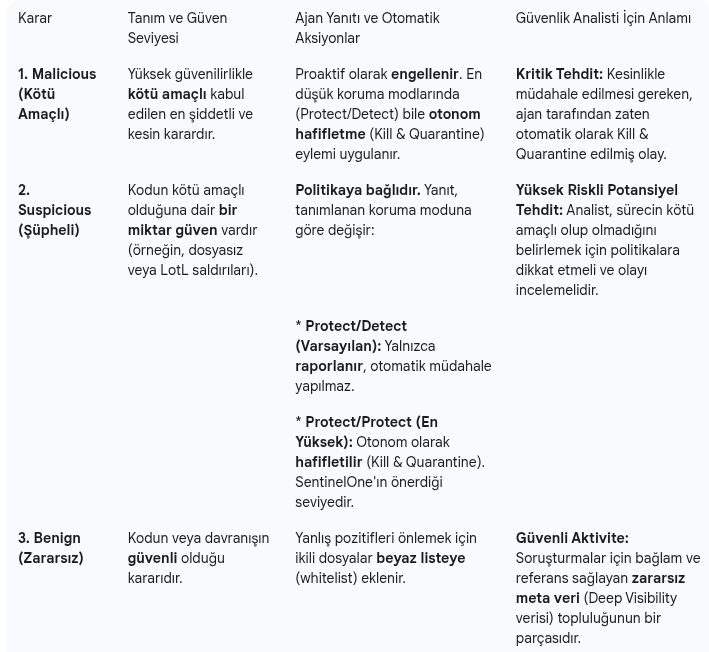
To minimize risk, SentinelOne recommends enabling Protect/Protect mode, which automatically Kill & Quarantine both Malicious and Suspicious threats. This utilizes the agent’s autonomous intelligence to the fullest, eliminating the attacker’s range of action with zero latency.
Unified Data Layer: Singularity Data Lake Link to heading
Singularity Data Lake is the foundation of the platform’s XDR capabilities and is a central data layer positioned as “an industry-first data lake” by SentinelOne. All telemetry data from endpoint, cloud infrastructure, identity systems, and third-party sources are collected in this single repository. This architecture provides the following key benefits:
- Holistic Visibility: By querying data from different systems from a single interface, security teams can holistically see how an attack spreads from the endpoint to the cloud or which resources an identity breach gained access to.
- Cross-Domain Correlation: Pooling data into a single pool enables AI engines to reveal complex attack chains by correlating otherwise imperceptible signals across domains.
- Standard Data Structure: Data from different sources are normalized in the Open Cybersecurity Schema Framework (OCSF) standard. This standardization makes it possible to index data consistently and query it efficiently with tools such as DQL (Deep Visibility Query Language).
These basic architectural elements of the platform lay the groundwork for creating a defense mechanism that is not only reactive but also proactive and autonomous against threats.
Autonomous Protection and Response Mechanisms Link to heading
The strategic value of the SentinelOne Singularity Platform lies in its capacity to autonomously block and neutralize threats at machine speed, without the need for human intervention. These capabilities directly reduce alert fatigue and manual response burden on Security Operations Center (SOC) teams, allowing analysts to focus on more strategic and complex threats, thus optimizing operational efficiency. The autonomous power of the platform comes from the combination of multi-layered artificial intelligence engines and patented technologies.
Multi-Layered Security Engines Link to heading
The platform uses two core AI engines that focus on different stages of the threat lifecycle:
- Static Artificial Intelligence (Pre-Execution): This engine is activated before the files are executed. Unlike traditional signature-based antivirus solutions, it analyzes the file’s structure and properties using machine learning models. In this way, it proactively blocks malware that has never been seen before (zero-day) or that constantly changes itself (polymorphic), without requiring a signature.
- Behavioral Artificial Intelligence (On-Execution): After a process is run, this engine monitors its behavior in the operating system, system calls, and interactions with other processes in real time. It is specifically designed to detect fileless attacks, “Living off the Land” (LotL) techniques and in-memory exploits. This engine recognizes an attack chain formed by a series of suspicious actions by focusing on Indicators of Attack — IoA rather than individual events.
Contextual Analysis with Storyline Technology Link to heading
SentinelOne’s patented Storyline™ technology automatically correlates thousands of raw EDR events, such as file creation, registry modification, network connectivity, and inter-process interactions, into a single understandable and actionable attack story. This technology allows analysts to see all steps of the threat, from its origin to its final impact, in a single visual interface, rather than manually combining hundreds of separate alerts. Storyline™ reduces root cause analysis — RCA to seconds, significantly reducing alert fatigue and accelerating response processes.
Ransomware Rollback Mechanism Link to heading
The Rollback mechanism, one of the most powerful responses to ransomware attacks, is designed to undo the damage caused by the attack. The technical steps of the mechanism are as follows:
- Behavioral AI engine detects ransomware activity and terminates the malicious process instantly.
- The agent associates all file and system changes affected by the attack under the Storyline™ ID.
- When the analyst issues the Rollback command with a single click, the platform uses the Windows VSS (Volume Shadow Copy) infrastructure to restore only the changes associated with this Storyline to the clean state just before the attack.
This precise and targeted restoration ensures business continuity by eliminating the need to pay ransom.
Customized Detection and Response: STAR Rules Link to heading
Storyline Active Response (STAR) allows security teams toIt is a powerful engine that allows you to create custom detection and response rules for specific threats. Analysts can turn the Deep Visibility Query Language (DQL) queries they use during threat hunting into persistent and autonomous detectors. When a STAR rule matches a specific behavior pattern, it triggers predefined autonomous actions:
- Alert: Generates only one alert.
- Kill Process: Immediately terminates the process that triggered the rule.
- Quarantine: Eliminates the risk of lateral movement by isolating the device from the network.
This capability strengthens defensive posture by enabling SOC teams to shift from reactive threat hunting to proactive and customized protection.
Artificial Intelligence Guided Security Operations (The Autonomous SOC) Link to heading
With its “Autonomous SOC” vision, SentinelOne emphasizes the strategic importance of moving security operations from human speed to machine speed. At the center of this vision are Generative and Agentic AI technologies, which ease the workload of analysts and reduce decision-making processes to seconds. This approach not only blocks threats but also creates strategic business value by maximizing the efficiency of security teams.
Purple AI: Strengthening Analyst Skills Link to heading
Purple AI functions as an “AI security analyst” built into the platform. Instead of raw data and complex interfaces produced by traditional security tools, Purple AI offers analysts a natural interaction. Its main abilities are:
- Natural Language Querying: Analysts ask “What PowerShell commands were run on this device in the last 24 hours?” It automatically translates the questions it asks in natural language, such as, into DQL queries that the platform understands.
- Automated Triage and Summarization: Analyzes thousands of alerts, prioritizing those with the highest risk, creating summaries of events and providing analysts with guided investigation steps.
- Productivity Increase: As noted in the 2025 Gartner® Magic Quadrant™ report, these capabilities can reduce the time to understand, investigate and resolve an incident (Mean Time to Respond — MTTR) by up to 55%.
Singularity Hyperautomation: No-Code Automation (SOAR) Link to heading
Singularity Hyperautomation is the platform’s built-in, code-free automation engine. This engine automates Tier-1 analyst tasks that require manual intervention, freeing up valuable time and reducing operational costs for senior analysts to focus on proactive threat hunting.
- Drag-Drop Workflows: Analysts can create complex security workflows (playbooks) using a drag-and-drop interface. These playbooks define a series of actions that will run automatically when a threat is detected.
- On- and Off-Platform Integration: Automation includes not only actions within the SentinelOne platform (such as quarantining the device), but also integrations with third-party systems (SIEM, firewall, ITSM tools). With this capability, Hyperautomation aims to replace traditional SOAR solutions.
AI-SIEM: Real-Time Data Analysis Link to heading
The AI-SIEM concept transforms traditional SIEM (Security Information and Event Management) approaches by running on Singularity Data Lake. While traditional SIEMs often rely on strict rules and manually written queries, AI-SIEM offers algorithmic analysis.
- Real-Time, AI-Powered Detections: AI-SIEM analyzes all data (endpoint, cloud, identity) flowing into the data lake in real-time. Machine learning algorithms go beyond predefined rules and detect anomalous patterns and hidden threats that deviate from normal behavior.
- Efficiency and Scalability: This approach eliminates time spent on rule and query management and provides a more efficient and scalable detection mechanism for large data volumes.
These AI and automation components take the platform’s core capabilities one step further, making security operations smarter, faster and more efficient.
Extended Detection and Response (XDR) Capabilities Link to heading
SentinelOne’s XDR strategy aims to provide a holistic security posture across the entire enterprise attack surface by extending protection beyond traditional endpoints. The Singularity Platform seamlessly combines endpoint, cloud, and identity data through its single-agent and unified data lake architecture, providing analysts with the full context of attacks.
Singularity Cloud Security (CNAPP) Link to heading
SentinelOne’s cloud security approach is designed as a comprehensive Cloud-Native Application Protection Platform (CNAPP) that combines two key components. This platform ensures both the security of the cloud infrastructure and the protection of the workloads running on it.
- CWPP (Cloud Workload Protection Platform): This module focuses on runtime protection of virtual machines, containers and serverless workloads on cloud providers such as AWS, Azure and GCP. Especially in Linux environments, the use of eBPF (Extended Berkeley Packet Filter) technology ensures runtime security in a safer and resource-efficient way by eliminating the risks of system instability and “kernel panic” that traditional kernel modules can cause.
- CSPM (Cloud Security Posture Management): This component detects misconfigurations, weak security settings and compliance violations in the cloud infrastructure. SentinelOne’s strategic PingSafe acquisition transforms its vision in this space by adding powerful agentless CNAPP capabilities to existing agent-based protection. This move “redefines what cloud security means,” transforming SentinelOne from a reactive player in cloud security to a proactive, full-lifecycle leader.
Singularity Identity Security (ITDR) Link to heading
The platform’s identity security module protects against attacks targeting critical identity infrastructures such as Active Directory (AD) and Azure AD. This module detects and blocks advanced techniques used by attackers to move laterally within the network and escalate privilege.
- Advanced Attack Detection: Detects in real time sophisticated identity-based attacks that traditional security tools may miss, such as
Pass-the-HashandGolden Ticket. - Deception Technology: The agent creates fake credentials and decoy systems to mislead attackers. When an attacker tries to access these fake resources, the security team is immediately alerted, stopping the attack at an early stage.
Threat Hunting & Forensics Link to heading
The Singularity Platform provides security teams with advanced tools to conduct proactive threat hunting and in-depth digital forensics analysis.
- Deep Visibility (Event Search): Security analysts can search in seconds across all endpoint telemetry stored in the Singularity Data Lake using Deep Visibility Query Language (DQL). This capability enables proactive threat hunting and deepening post-incident forensic analysis by searching for a specific threat indicator (IOC) or pattern of behavior (TTP) across the entire organization.
- RemoteOps Forensics: This tool provides the ability to centrally orchestrate incident response (IR) and digital forensics (DFIR) processes. Security teams can run remote scripts (PowerShell, Bash, etc.) on thousands of endpoints simultaneously, collect forensic evidence (event logs, memory dumps, etc.) and take immediate response actions. It is important to note that RemoteOps works on existing agents and is not a tool for new agent deployment.
Market Validation and Competitive Positioning Link to heading
The technical superiority of a cybersecurity platform only makes strategic sense when it is proven by independent and objective third-party evaluations. The SentinelOne Singularity Platform’s autonomous protection and AI-driven efficiency claims are consistently validated by the industry’s most respected tests and analyst reports.
MITRE ATT&CK Evaluation Results Link to heading
MITRE Engenuity ATT&CK® Evaluations are one of the most prestigious tests that measure a platform’s detection and visibility capabilities against real-world attack scenarios. SentinelOne achieved outstanding results in the 2024 Enterprise Assessment, proving its autonomous capabilities.
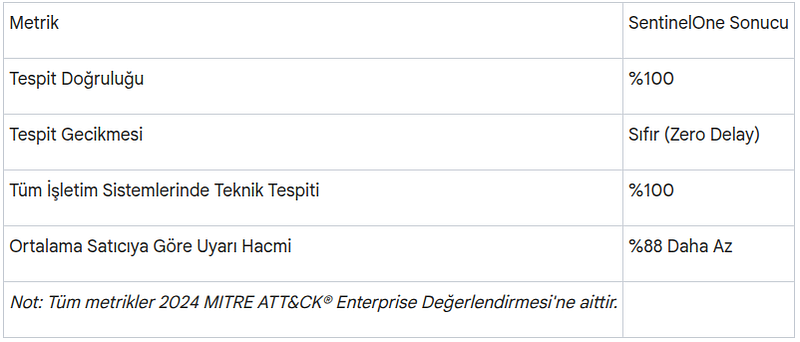
Among these results, generating 88% fewer alerts than the average seller is one of the most critical data of the report. This metric concretely confirms the platform’s “Autonomous SOC” vision. The effectiveness of the artificial intelligence-supported filtering mechanism has a direct effect by preventing analyst burnout and increasing operational efficiency (OpEx). It creates business value. This is proof of how a technical metric turns into a strategic outcome.
Industry Analyst Recognition Link to heading
SentinelOne’s leading position in the market is confirmed by leading industry analysts:
- Gartner® Magic Quadrant™ for Endpoint Protection Platforms: SentinelOne has been recognized as a “Leader” in this report for the fifth consecutive year. This consistency demonstrates the integrity of the platform’s vision and its ability to meet the needs of the market.
- Frost & Sullivan: The company named SentinelOne a “Growth and Innovation Leader.” This recognition signals the platform’s strategic investments not only against current threats but also towards the security challenges of the future.
Financial Analyst Perspective and Growth Link to heading
The technical and market leadership of the platform also attracts the attention of financial analysts. Berenberg, one of the leading investment banks, initiated an analysis for SentinelOne with a “Buy” rating. According to Berenberg, the company’s strong growth trajectory in annual recurring revenue (ARR) is based on two key factors:
- Transition from Old Generation Antiviruses to Artificial Intelligence-Driven EPP: Institutions are now realizing that signature-based protection is insufficient and are switching to artificial intelligence-focused, autonomous platforms such as SentinelOne.
- Strong Performance in the Midsize Market: SentinelOne has created a sustainable growth momentum by achieving a strong adoption rate, especially in the midsize business market.
These external validations are a clear indication that the technical and operational advantages offered by the SentinelOne Singularity Platform have translated into tangible market success.
Strategic Implications for Cybersecurity Teams Link to heading
This analysis reveals that the SentinelOne Singularity Platform is a strategic transformation platform for the modern Security Operations Center (SOC) with its autonomous, unified and AI-driven architecture. This integrated approach breaks down traditional security silos and creates a faster, smarter and more efficient line of defense against threats. The architectural advantages of the platform turn into concrete advantages for cyber security professionals by providing clear answers to the question “How does SentinelOne differ from its competitors based on its architecture?”
- Reduced Time to Response (MTTR) and Increased SOC Efficiency The platform’s autonomous response capabilities, Ransomware Rollback mechanism and Purple AI-powered triage processes minimize dependence on human intervention. The high signal-to-noise ratio (88% fewer alerts), proven by MITRE ATT&CK® benchmarks, allows analysts to focus on real, critical threats rather than struggling with false positives. This significantly reduces mean time to response (MTTR) and maximizes the overall efficiency of SOC teams.
- Integrated Visibility and Reduced Complexity The platform’s architectural elimination of silos eliminates the reliance on expensive and fragile API integrations that are mandatory in competing ecosystems. By combining different security layers such as EPP, CWPP, and ITDR under a single roof, single agent architecture and Singularity Data Lake eliminate the operational complexity, integration costs, and visibility gaps that come with organizations managing multiple different security vendors.
- Future Security Investment While SentinelOne’s investments in areas such as CNAPP (with the acquisition of PingSafe) and AI SIEM show that the platform is ready for today’s threats, the step it has taken with the purchase of Prompt Security reveals a much more forward-looking vision. This move moves SentinelOne’s strategy from a “Security for AI” approach (protecting existing systems with AI) to a vision of “Security of AI” (protecting the productive AI tools that enterprises use). For organizations migrating to cloud and artificial intelligence-focused infrastructures, the Singularity Platform offers a future-proof and sustainable security investment that can manage the risks brought by these new technologies. This vision transforms the platform from a technological tool into a strategic business partner in the digital transformation journey of institutions.